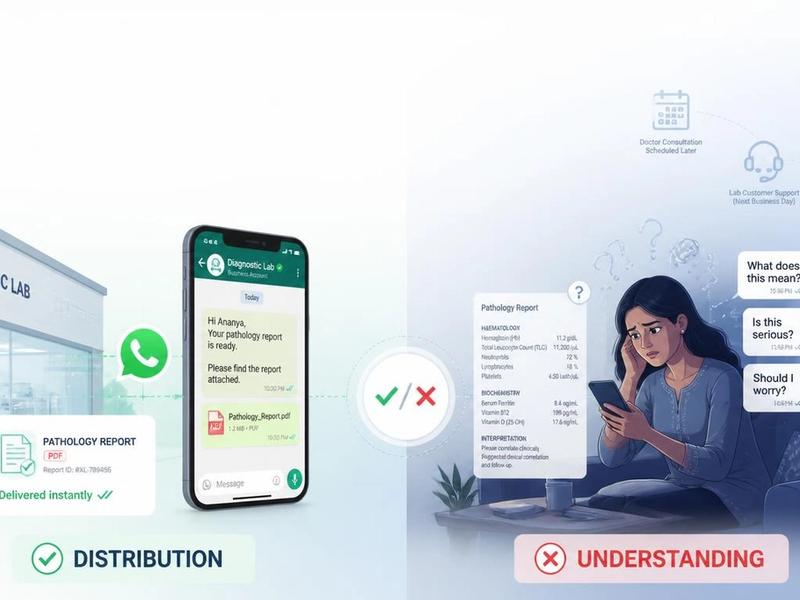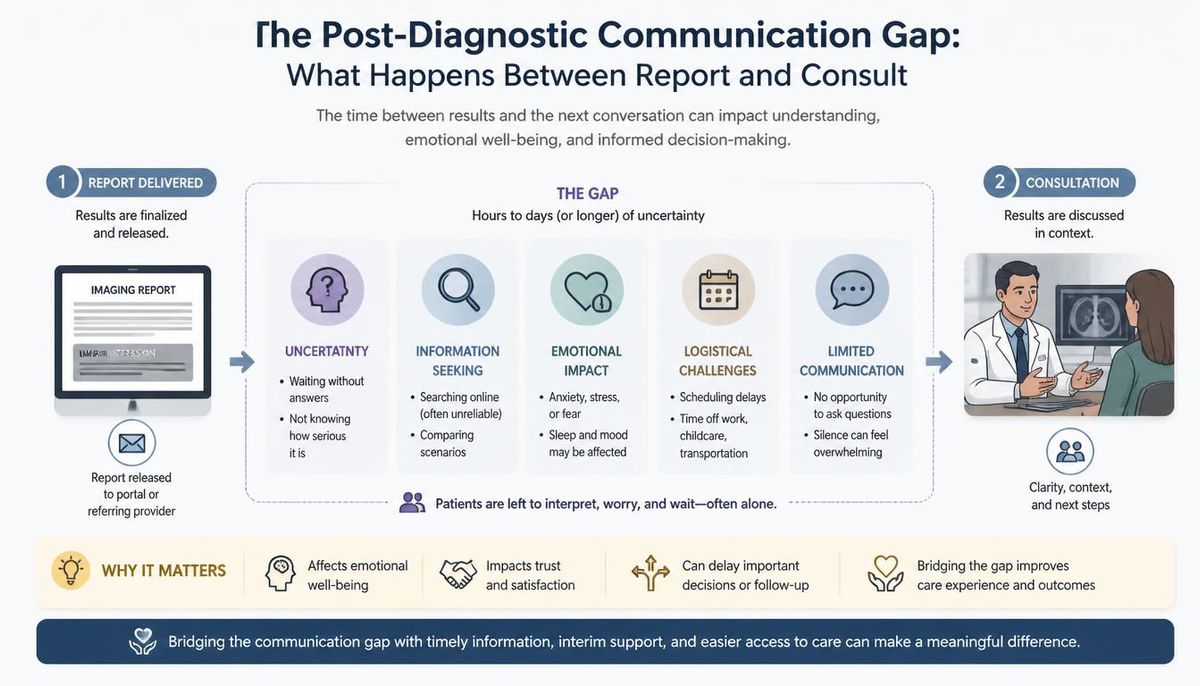
The post-diagnostic communication gap is the period between a patient receiving their diagnostic report and discussing it with a clinician. Immediate-release rules made this gap universal. Report language made it stressful. For diagnostic centers and labs, it surfaces as call volume, complaints and referral risk, which makes it an operational problem, not a clinical one.
A patient collects a CT report at 6pm on a Friday. Their consultation is the following Thursday. Between those two moments sit nine days, one PDF written for a physician, and a search engine.
Nothing clinical happens in those nine days. A great deal of operational activity does: phone calls your front desk cannot resolve, a WhatsApp message to whoever at your center last answered kindly, a review written in a state of alarm, and occasionally a patient who arrives at the consult having already decided what is wrong with them. We have documented separately what that wait actually feels like from the patient's side.
Most diagnostic centers treat this as noise, an unavoidable byproduct of patients being patients. It is not noise. It is a defined, repeating, measurable stage of your service that currently has no owner, no process and no design. This piece names it, breaks it into four stages, and sets out what a center can actually do about each.
Why the gap exists now, and did not ten years ago
For most of the history of diagnostic medicine, the report went to the referring clinician, and the patient learned what it meant when a doctor told them. The gap was invisible because patients were not in it. Two shifts changed that.
In the United States, immediate release became the default. Under the 21st Century Cures Act information blocking regulations, applicable to health care providers since 5 April 2021, patients have rapid electronic access to test results and may receive them in parallel with the ordering clinician rather than after them. Clinical laboratories and imaging centers fall within scope. Narrow exceptions exist, including the harm exception and certain state laws governing how specific diagnoses must be conveyed, but delay is no longer a general-purpose operating choice. HHS finalised disincentives for providers found to have committed information blocking, effective 31 July 2024. We have written at length on why immediate release makes patient understanding a provider problem.
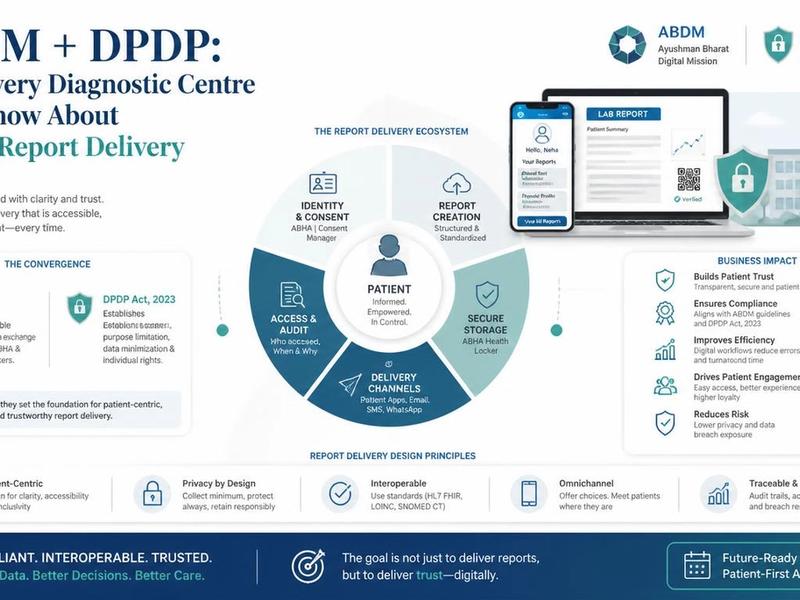
In India, digital delivery became the norm. Under the Ayushman Bharat Digital Mission, ABHA-linked health records let patients receive digital lab reports and diagnoses directly from verified providers under a consent-based framework, with labs participating through ABDM-enabled systems. Alongside that, a large share of diagnostic centers already deliver reports by WhatsApp, email or a patient app, often within hours of the scan.
The uncomfortable finding: patients want this, and it still worries them
It is tempting to conclude that immediate release was a mistake. The evidence does not support that, and centers that argue it will lose.
In a survey of 8,139 respondents across four US academic medical centers, 96% preferred to receive test results immediately online even when their clinician had not yet reviewed them. Patients are not asking to be protected from their own data.
But in the same study, 7.5% reported that seeing results before being contacted increased their worry, and that figure splits sharply by outcome. Among patients whose results were normal, 5.0% reported increased worry. Among those whose results were abnormal, it was 16.5%. Preference also varies by severity: most respondents still preferred to hear serious findings, such as a cancer diagnosis, directly from a clinician.
Patients overwhelmingly want their results immediately. A meaningful minority, concentrated exactly among those with abnormal findings, are made more anxious by receiving them. The problem is not access. The problem is that access arrived without comprehension.
Why comprehension fails: the report was never written for them
Radiology and pathology reports are professional instruments. They are written by a specialist, for a specialist, using deliberately precise hedged language that means something exact to a clinician and something terrifying to everyone else.
The readability evidence is stark. An analysis of 97,052 radiology reports found a mean length of roughly 17.6 sentences and 203 words, with only 4.2% written at a reading grade level of 8 or below, approximately the reading level of the average US adult. Guidance for patient-facing materials is typically stricter still, at around a sixth-grade level. One study found that fewer than half of patients described their radiology report as easy to comprehend. We have also reviewed what the recent evidence on simplified reports actually shows.
This is not a failure of radiology. A report optimised for patient reassurance would be a worse clinical document. The report is doing its job. It is simply doing a job that is no longer the only job being asked of it.
The four stages of the gap
The gap is not one event. It is a predictable sequence, and each stage has a different cost and a different intervention point.
Stage 1: Release (T + 0)
The report becomes available to the patient: portal notification, WhatsApp message, email, or a printed copy at the counter. What actually happens: the patient opens it immediately. Almost nobody waits. The document they open contains an Impression section written in clinical shorthand. What it costs you: nothing yet. This is the only stage you fully control, and the only one where a small change alters everything downstream.
Stage 2: Panic (T + minutes)
The patient encounters a term they do not recognise, such as lesion, hypodense, clinical correlation advised, or cannot be excluded, or notices a measurement in millimetres with no reference range. What actually happens: the patient assumes the worst plausible interpretation of an ambiguous finding. Hedged clinical language, which exists to preserve diagnostic accuracy, reads to a layperson as concealment. Cannot be excluded is heard as probably. What it costs you: this is where anxiety is created, and where the 16.5% figure lives. It is also where your center's perceived quality is set, because in the patient's mind the report and the center that produced it are the same thing.
Stage 3: Search (T + hours)
The patient searches the exact phrase from their report, then the worst-case condition it returns, then forums. What actually happens: they find general medical content written for no one in particular, calibrated to no specific finding, and frequently anchored on the most serious cause. They cannot tell which paragraph applies to their 8mm finding versus an 80mm one. What it costs you: the patient's understanding of their own result is now being formed by third parties with no access to their report and no relationship with your center. If they call at this point, your front desk is not answering a question, it is correcting a conclusion.
Stage 4: Consult (T + days)
The patient meets the clinician, carrying whatever they assembled in stages 2 and 3. What actually happens: the appointment opens with de-escalation rather than discussion. Clinician time is spent unwinding a misconception before the actual conversation can begin. For follow-up patients the same dynamic applies to comparing a new report against a previous one, where the wording that signals change is easily misread. What it costs you: referrer friction. Clinicians notice which centers send them patients who arrive calm and oriented, and which send patients who arrive frightened and pre-diagnosed. In a referral-driven business, this is not a soft cost.
The counterintuitive part: faster reporting makes the gap worse
Most centers invest in turnaround time. It is measurable, it is competitive, and it is genuinely valuable. But turnaround time and understanding are different problems, and improving the first without touching the second widens the gap rather than closing it. Cut reporting from 48 hours to 4 and you have not shortened the wait for meaning, because the consultation date has not moved. You have simply given the patient more time alone with a document they cannot read.
Faster reports do not produce calmer patients. They produce longer gaps.
What it costs your center: run your own numbers
Industry-average cost figures for this are not reliable, and you should be sceptical of any vendor who quotes one. Use your own data instead. Four inputs you already have:
- Report-related inbound contacts per month. Count calls and messages where the patient is asking what something means, rather than about scheduling, billing or collection. Most centers have never separated these two categories, and are surprised by the split.
- Average handling time, including the escalations your front desk cannot resolve and passes to a technologist or radiologist.
- Fully loaded cost per staff-minute for whoever absorbs that time.
- Reviews and complaints referencing confusion or fear, as a share of total negative feedback.
Multiply the first three and you have a monthly figure for the gap. The fourth tells you what it is costing in reputation, which is larger and slower to repair. The point of this exercise is not the total. It is the realisation that the cost is currently distributed invisibly across people whose job descriptions do not mention it.
Four operating options
There are only four honest responses. Three of them are already in use at most centers, usually without anyone having chosen them deliberately.
| Option | What it involves | Cost | Regulatory viability | Realistic verdict |
|---|---|---|---|---|
| 1. Do nothing | Release the report and absorb the calls informally | Hidden but real; scales linearly with volume | Compliant | The default. Costs the most while appearing to cost nothing |
| 2. Delay release | Hold results until a clinician can explain them | Low direct cost | Not generally viable in the US under information blocking rules, outside narrow exceptions | Largely closed as an option, and patients do not want it |
| 3. Add human explanation | Staff or clinicians call patients to explain reports | High and linear; every additional scan adds minutes | Compliant | Excellent and unscalable. Works at low volume, breaks with growth |
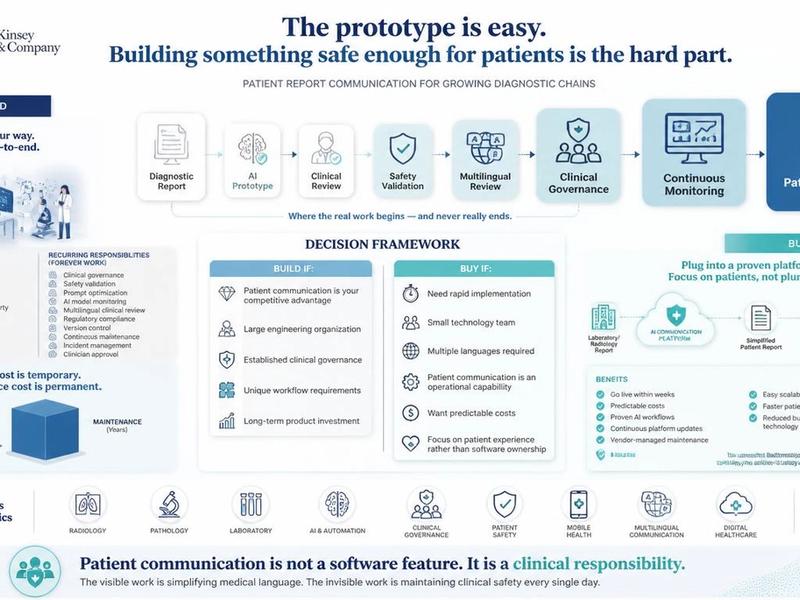
| 4. Add an explanation layer | Deliver a plain-language explanation alongside the report, automatically | Fixed; does not scale with volume | Compliant, and supports rather than delays release | Only option that scales, but demands vendor scrutiny |
Option 3 deserves particular respect. Centers that do it well produce genuinely superior patient experience. The constraint is arithmetic: it consumes the time of your most expensive people, and the burden grows exactly as you grow.
An action checklist
Regardless of which option you choose, five things are worth doing this quarter:
- Instrument the gap. Add a single tag in your front-desk log distinguishing report comprehension contacts from scheduling and billing. One month of data will tell you more than any benchmark.
- Audit your own Impression sections. Take twenty recent reports and count how many contain at least one hedged clinical phrase with no plain-language equivalent anywhere in the document.
- Check what your report delivery message says. Many centers deliver a PDF with no accompanying text at all. The message that carries the report is free real estate for setting expectations.
- Ask your referring clinicians one question: how much of a first consult is spent correcting misunderstanding? Their answer is your business case.
- Separate turnaround time from understanding in how you report patient-experience metrics internally, so improvements in one are not mistaken for progress in the other.
Where this goes next
The gap is not a temporary artefact of a regulatory transition. Immediate release is now the settled direction of travel in both the US and India, and patients have made clear they prefer it. The report will keep arriving first.
Which means the question for diagnostic centers is not whether to close the gap, but who owns it. Right now, in most organisations, the answer is nobody, which is precisely why it costs what it does.