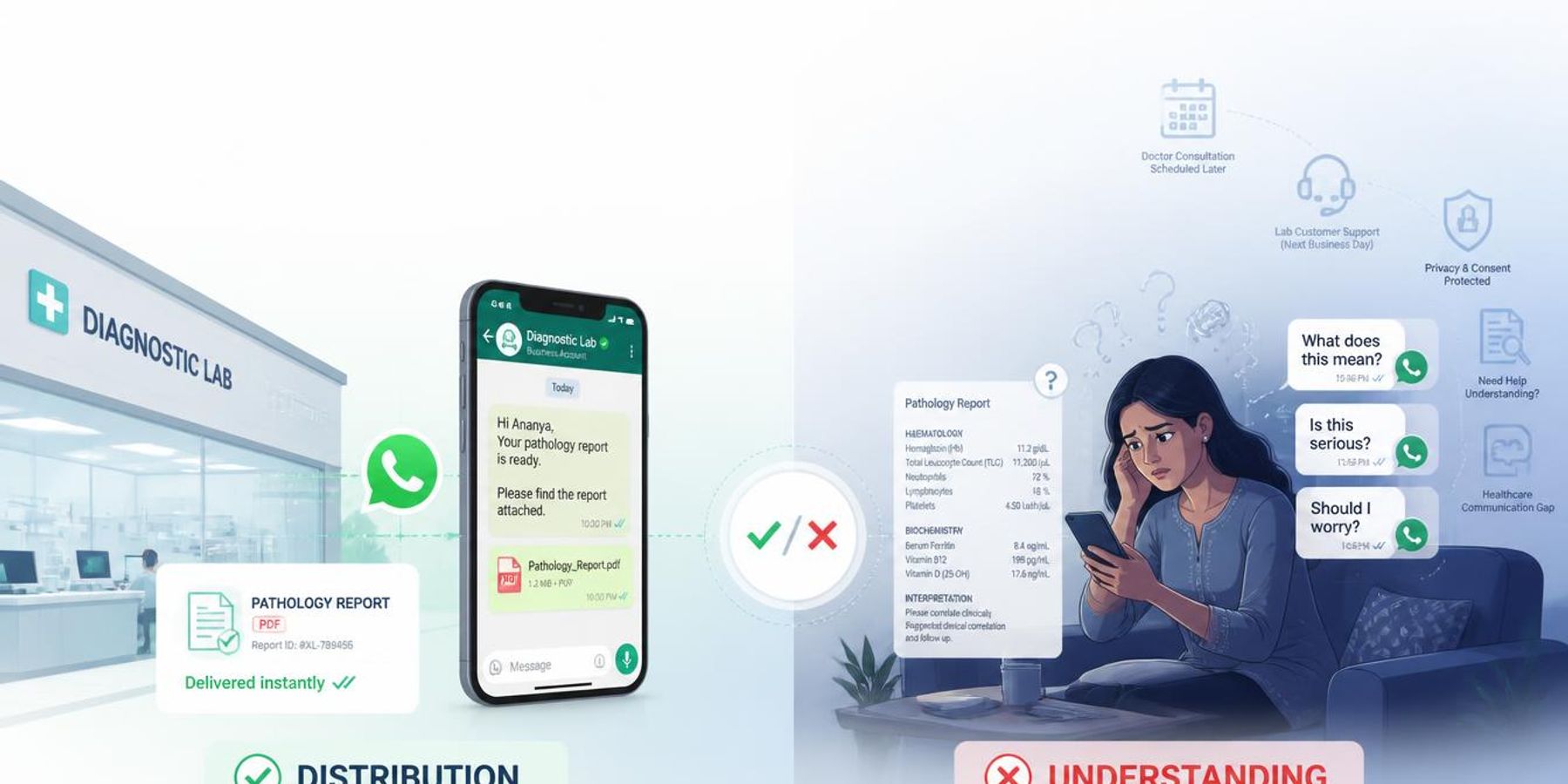
WhatsApp has become the default report delivery channel for a large share of Indian diagnostic centres because it is fast, requires no app adoption, and reaches patients where they already are. What it does not do is make the report readable. The channel solved distribution and left comprehension untouched, which is why WhatsApp-first labs often see report questions rise rather than fall.
This is not an argument against WhatsApp. For most Indian labs it is the correct channel, and the alternatives are worse. It is an argument for being precise about what it solved, because the gap it left is now the operational problem.
What WhatsApp genuinely got right
Patient apps failed in India for a simple reason: nobody wants a separate app for a lab they visit twice a year. Portals failed for the same reason with an extra login. WhatsApp bypassed the adoption problem entirely. Delivery is near-instant, delivery confirmation is visible, the patient can forward the report to family or a doctor without instruction, and there is no password to reset at 9pm. Measured purely as distribution, it is close to optimal.
The three things it made worse
1. It shortened the runway to panic
A report collected from the counter arrives during working hours, often with a person nearby. A report arriving on WhatsApp reaches the patient at 9pm on a Saturday, alone. The consultation date has not moved, so the gap between receiving the report and understanding it has simply become longer and less supervised.
2. It made you contactable
A PDF sent from a business number is an invitation to reply on that number. Patients do, at all hours, with clinical questions. Many labs now run an informal, unstaffed, unlogged clinical helpdesk inside a messaging app, usually staffed by whoever happens to see the notification. That is an operational and clinical governance issue, not a customer service one.
3. It removed the moment of explanation
Counter collection had one underrated feature: a human handed the report over, and patients asked their first question there. That interaction was brief and rarely clinical, but it defused a great deal. Digital delivery removed it and put nothing in its place.
WhatsApp solved the problem of getting the report to the patient. It did nothing about the problem of the patient understanding it, and by removing the counter conversation it quietly made that second problem worse.
Two assumptions worth checking
First, consent. Sending a report to a number captured at registration is not automatically the same as specific, revocable consent to that channel. Under India's DPDP framework, you are the data fiduciary and accountability sits with you regardless of which channel or vendor you use. Worth confirming what your registration form actually says.
Second, the word encrypted. WhatsApp messages are encrypted in transit, and vendors selling Business API integrations lean on this heavily. It is a narrower claim than it sounds. It says nothing about who at your integration provider can access message content, how long they retain it, where it is stored, or which sub-processors are involved. Those are separate questions with separate answers, and they are the ones that matter for your accountability. Ask them specifically rather than accepting the encryption headline.
What to send alongside the PDF
Most labs send a bare file with no message, or a line of branding. That message is free space and it is doing nothing. Four things belong there.
| Include | Why |
|---|---|
| A plain-language explanation alongside the report | Answers the vocabulary questions before they become messages |
| Explicit next step: who to show this to | Navigation questions are a large share of contacts and need no clinician |
| A clear statement that this is not a diagnosis | Sets expectation and protects you |
| A visible route for urgent concerns | Urgency questions must reach a clinician, not sit unread in a chat queue |
None of this requires changing channel or delaying release. It changes what travels with the report, which is where most report questions can be resolved before they arrive.