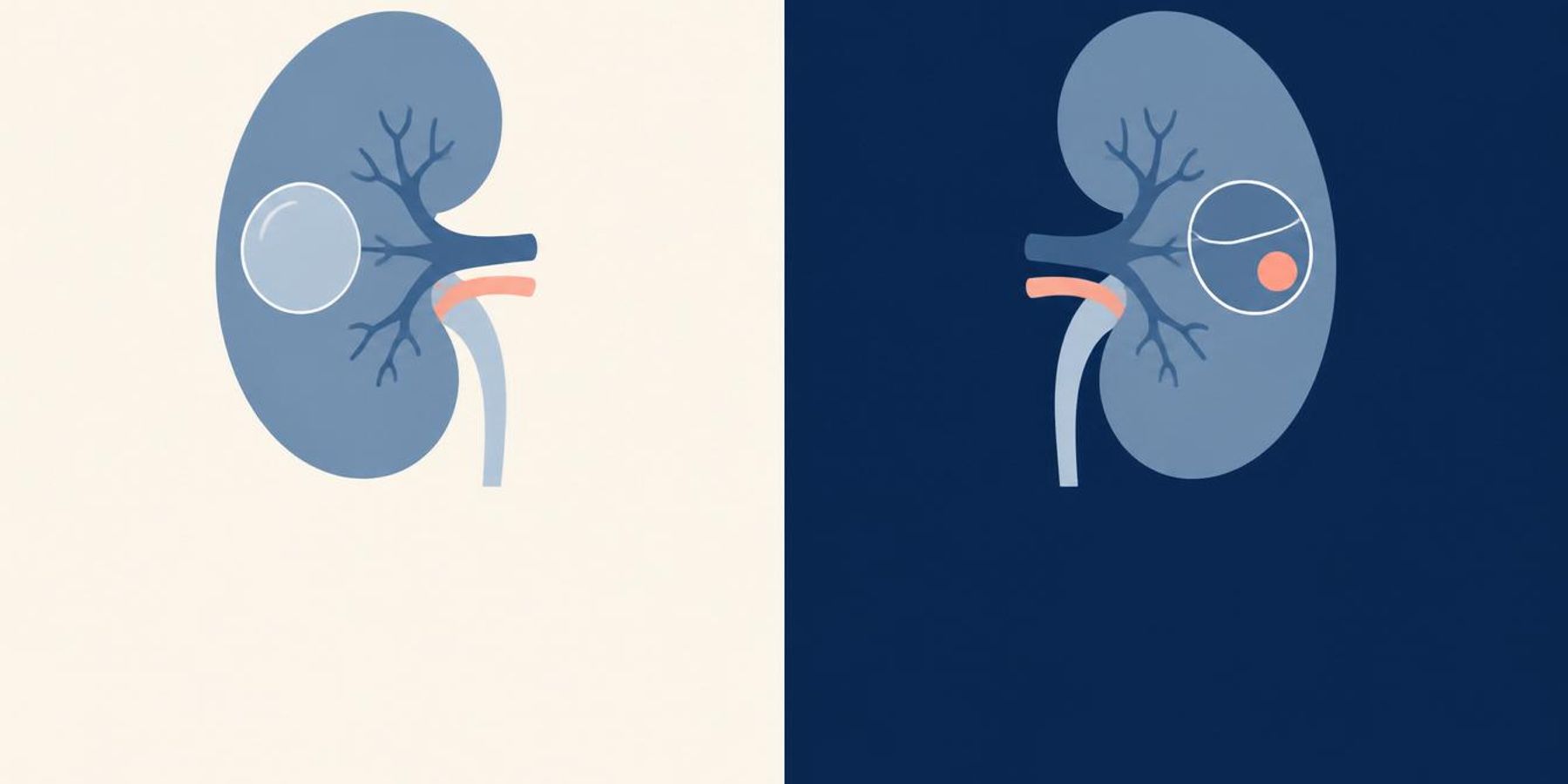
The honest answer to what size of kidney cyst is dangerous is that size alone rarely decides, and most kidney cysts are not dangerous at any size. Let us break it down. Your kidneys are the two bean-shaped organs that filter your blood and make urine. A cyst is a small sac filled with fluid, a bit like a tiny water balloon. A kidney cyst, also called a renal cyst since renal simply means related to the kidney, is one of these fluid pockets sitting on or inside the kidney. They are extremely common, especially as we get older, and the large majority are simple, harmless, and cause no problems at all. What matters far more than the size is the type of cyst, whether it holds only clear fluid or has other features inside it. A big simple cyst is usually fine. A small complex one may deserve a closer look. On your report, the size and type are a description of what the scan showed, not a diagnosis.
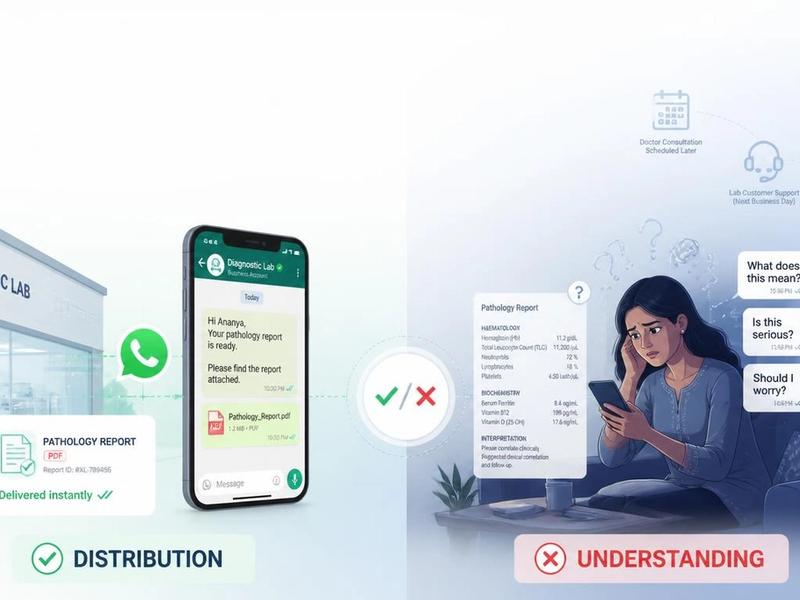
If you are reading this because an ultrasound or CT report just landed on your WhatsApp, maybe yours, maybe your father's or your mother's, and a number in centimetres is making your heart race, take a breath. This page explains what the size really tells you, what simple and complex mean, what the Bosniak grade on some reports means, and what to ask your doctor. And if the rest of the report still reads like a foreign language, FlexReport can help. Upload it on app.flexreport.ai and get a simplified, plain-language version of the whole thing in minutes.
What size of kidney cyst is dangerous?
There is no single size at which a kidney cyst becomes dangerous, and that surprises most people. A simple cyst, one filled with clear fluid and having a thin smooth wall, is usually harmless even when it is quite large, and many people carry a 4 cm or 5 cm simple cyst for years without any trouble. On the other hand, a complex cyst, one with thicker walls or solid parts, can deserve attention even at a small size. So size is one input, not the verdict. Where size does start to matter is comfort and pressure. A very large cyst, often past about 7 to 10 cm, is more likely to press on nearby structures, cause a dull ache in the side, or occasionally affect how the kidney works, which is why doctors may keep an eye on bigger cysts even when they are simple. But the question your doctor really answers is not how big, it is what kind, and then how big. Size is read alongside the type, your symptoms and any change over time (Radiological Society of North America).
Here is the reassuring bit. Radiologists describe every cyst they see, including tiny harmless ones, because recording everything is their job, the way a building surveyor notes every hairline crack whether or not it matters. A cyst appearing on your report is not the same as your doctor being worried about it. Listing it is duty. Deciding whether it matters is your doctor's call, and for most kidney cysts the answer is that it does not.
Renal cyst size on your report: a plain-English guide
The renal cyst size on your report is simply how wide the cyst measured, usually written in centimetres (cm) or millimetres (mm), where 1 cm equals 10 mm and one centimetre is about the width of a fingernail. A bigger number is not automatically worse, especially for a simple cyst. The guide below shows how different sizes are commonly viewed when the cyst is simple. If your report calls the cyst complex, or gives a Bosniak category of III or IV, the size matters much less than those features, and the next section explains why. Treat this table as a way to read your report calmly, not as a rulebook. Your doctor's reading of your specific scan always comes first.
| Simple cyst size | In everyday terms | How it is commonly viewed |
|---|---|---|
| Under 3 cm (under 30 mm) | Smaller than a grape | Very common, usually harmless, often no action |
| 3 to 5 cm (30 to 50 mm) | Grape to a small lime | Still usually harmless, may just be noted |
| 5 to 7 cm (50 to 70 mm) | Small lime to a lemon | Often fine, but may be watched if it causes symptoms |
| Over 7 to 10 cm (over 70 to 100 mm) | Larger than a lemon | More likely to cause pressure or ache, may be reviewed for drainage |
With kidney cysts, the real question is not how big, it is what kind. Type comes first, size comes second.
Bosniak classification in plain terms
The Bosniak classification is a scale radiologists use to sort kidney cysts by how likely they are to matter, running from category I to category IV. Think of it like a risk shelf, from the bottom shelf, which is completely ordinary, to the top shelf, which needs proper attention. A category I cyst is a plain simple cyst, harmless. Category II is a cyst with a couple of minor extra features, still considered benign. Category IIF, where F stands for follow-up, is an in-between group that is watched with a repeat scan to make sure it stays stable. Category III has more concerning features and usually needs further tests or a specialist opinion. Category IV has clearly worrying features and is treated seriously. The important thing to hold on to is that Bosniak is a way of sorting, not a diagnosis in itself. A higher number means a closer look, not a confirmed problem. The plain-language version is below.
| Bosniak category | In plain terms | What it usually means |
|---|---|---|
| I | A plain simple cyst | Harmless. No follow-up needed. |
| II | A simple cyst with minor extra features | Considered benign. No follow-up needed. |
| IIF (F = follow-up) | Slightly more detail, worth watching | Very likely benign, checked with a repeat scan. |
| III | More concerning features | Needs further tests or a specialist opinion. |
| IV | Clearly worrying features | Taken seriously and investigated fully. |
Is a kidney cyst serious? Is it cancer?
The large majority of kidney cysts are not serious and are not cancer. Simple cysts, which are by far the most common, are almost always benign, meaning non-cancerous, and usually need nothing more than being noted or occasionally watched. Only a small share of cysts, generally complex ones in the higher Bosniak categories, need further tests to be sure nothing is missed, and even then a closer look is not the same as a diagnosis. It simply means your doctor wants more information before deciding. What matters is the full clinical picture: your age, your symptoms, the type, size and Bosniak grade of the cyst, and whether it changes over time. Assembling that picture is your doctor's job, not a search engine's. A report line is one puzzle piece. Your doctor holds the whole puzzle.
What symptoms can a kidney cyst cause?
Most kidney cysts cause no symptoms at all and are found by chance during a scan done for something else entirely. When a cyst does cause symptoms, it is usually a larger one, and you might notice a dull ache or heaviness in your side or upper back, a feeling of fullness, or now and then a rise in blood pressure. These are usually mild and are not, on their own, a sign of anything sinister. There is a smaller set of warning signs that do deserve prompt attention, because occasionally a cyst can bleed, get infected, or press on the kidney. The callout below sets out exactly when to stop reading and get checked.
One gentle note for the sons, daughters and spouses who often manage a family member's health, because in many Indian homes that is exactly who is reading this. Older people in particular tend to brush off back or side pain as ordinary aches. If their report mentions a cyst, use it as an opening to ask how they have really been feeling. It makes the doctor's visit far more useful.
What happens next after this finding?
What happens next depends on the cyst's type, size and Bosniak grade, plus your symptoms, and for most people it is reassuringly low-key. For a simple cyst, doctors very often do nothing at all, or suggest a repeat scan after some months only if it is large. For a IIF cyst, the usual plan is a follow-up scan to confirm it stays stable. For higher-grade or clearly symptomatic cysts, your doctor may arrange further imaging such as a CT or MRI, a specialist referral, and in selected cases a procedure to drain a large painful cyst or remove a concerning one. Follow-up scans are a normal way of keeping watch, not a sign that something bad has been found (Radiological Society of North America).
A few useful questions to carry into your appointment:
- Is my cyst simple or complex, and what size is it?
- Does it have a Bosniak grade, and what does that mean for me?
- Do I need any treatment now, or can we watch it?
- When should I have a follow-up scan, and which symptoms should bring me back sooner?
Walking in with your questions written on your phone keeps a five-minute consult from ending before your doubts do.
FlexReport is a patient comprehension layer for diagnostic centers, labs, and hospitals. It adds a plain-language second view to clinical reports without altering the clinical report itself. FlexReport operates in India and is built by FlexRad, a unified radiology platform with DICOM and PACS infrastructure across India and the US.