Four years into the information-blocking era, most imaging leaders have made peace with the mechanics of immediate release. Reports flow to the portal the moment they're finalized. The compliance box is checked.
What fewer teams have confronted is the second-order effect: you are now, functionally, publishing radiology reports directly to patients — in language written for physicians — and absorbing the operational cost of the confusion that follows.
The numbers: patients are reading reports before their doctors
A 2024 study of a large multicampus health system published in AJR measured what immediate release actually changed. Before the information-blocking provisions took effect, the median time from report finalization to first patient access was 45 hours. After: 5.5 hours. The share of reports opened by the patient before the ordering provider rose from 18.5% to 44%.
In oncology settings, research published in JAMA Oncology found roughly 75% of test results were viewed by patients before the ordering clinician.
And patients want it this way. A multi-site JAMA Network Open survey found 95.7% of patients preferred to keep receiving immediately released results — including 95.3% of patients whose results were abnormal. Immediate release is not going to be walked back by patient demand, and the Preventing Harm exception is deliberately narrow. This is the operating environment now.
What this means for an imaging center, operationally
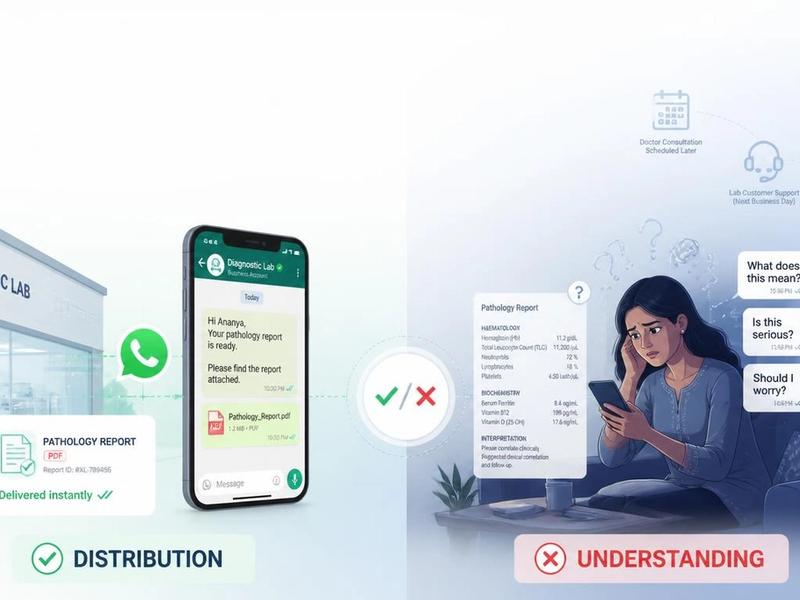
Think about what a patient does at 9 pm with a finalized MRI report that says "T2 hyperintense lesion, clinical correlation recommended."
They search each phrase. They land on worst-case content. Then they act — and every action lands on someone's desk:
The callback loop. Front-desk and nursing staff field calls asking what the report means — questions they often can't legally or practically answer, so they redirect to the ordering physician, who hasn't read the report yet. One report, three touchpoints, zero resolution.
The portal-message pile-up. Health systems have documented sustained growth in patient portal messages since immediate release. For outpatient imaging, those messages route to referrers — and referring physicians remember which imaging centers generate homework for them.
The anxiety tax. A patient who spends a weekend convinced an incidental finding is cancer is not a satisfied customer, whatever your scan quality and turnaround time. Patient-experience scores absorb the damage, and in a market where independent centers compete with hospital systems on experience, that's not a soft cost.
The referrer-relationship cost. This is the quiet one. When patients call their physician confused about a report your center released, you've exported your communication gap to the person who decides where the next hundred referrals go.
A framework: the comprehension gap window
Here is a simple way to size the problem for your own center. There are now two clocks running on every report:
- Time-to-access — finalization to patient opening the report. The Cures Act collapsed this from days to hours. You don't control it anymore.
- Time-to-understanding — patient opening the report to the patient actually knowing what it means. For most patients, this clock doesn't stop until the follow-up appointment, days or weeks later.
The space between the two is the comprehension gap window — and everything expensive happens inside it: the Googling, the calls, the portal messages, the anxiety, the occasional unnecessary ER visit. Regulation shrank the first clock and did nothing for the second. Every operational fix available to you is a way of shrinking the second clock, because the first one is federal law.
Four ways imaging centers are shrinking the window
1. Radiologist-written patient summaries. Some practices ask radiologists to append a plain-language impression. It works, and it's also the reason it doesn't scale: it spends your scarcest resource — radiologist time — on a communication task, and it collides with productivity targets. Realistic for low volumes, not for a center reading hundreds of studies a day.
2. Structured lay-language templates. Standardized patient-friendly explanations for common findings (degenerative changes, simple cysts, stable nodules). Cheap and consistent, but generic: a template can't tell a patient what their 6 mm nodule with their prior history means.
3. Front-loading expectations. Scripts at scheduling and check-out: "Your report may reach the portal before your doctor reviews it. Words like 'lesion' and 'unremarkable' often don't mean what they sound like." Costs almost nothing, measurably reduces panic — but manages expectations rather than closing the gap.
4. An AI patient-communication layer. The emerging option: software that takes the finalized report and generates a plain-language explanation specific to that report — what each finding means, what's routine versus what warrants a conversation, and which questions to bring to the follow-up. The evidence base is maturing: a Lancet Digital Health review covering 12,922 AI-simplified radiology reports found patients understood simplified reports nearly twice as well — with the important caveat that outputs need guardrails against oversimplification and error, which is why the credible deployments keep the original report intact and position the explanation as a companion, never a replacement.
Most centers will end up combining 2, 3, and 4. The decision framework is volume-driven: under ~50 studies a day, templates plus scripting may hold; above it, the callback math starts favoring automation.
Common mistakes when responding to immediate release
- Slow-walking releases to the edge of compliance. Delaying release invites information-blocking complaints (enforcement now carries real penalties) and patients still read the report alone — just angrier.
- Treating it purely as a compliance problem. Compliance was the easy part. The gap shows up in ops metrics: calls per study, portal messages per study, referrer complaints. If nobody owns those numbers, nobody fixes them.
- Making the radiologist the help desk. Radiologist-authored summaries at scale trade your most expensive hours for a task software and templates can carry.
- Replacing the report. Any patient-facing layer must supplement the original signed report, never alter it. The radiologist's language is the legal document; the explanation is a companion to it.
- Ignoring the upside. Centers that close the comprehension gap turn a regulatory burden into a differentiator: patients remember the imaging center that made the scariest document of their year understandable.
The strategic read
Independent imaging centers can't out-build hospital systems on capital equipment, and everyone's turnaround times are converging. Patient experience is the competitive surface that's left — and since April 2021, the report itself is patient experience, because the patient reads it first, alone.
The centers treating comprehension as a workflow to be designed — rather than an annoyance to be absorbed — are converting a federal mandate into the cheapest differentiation available in outpatient imaging.
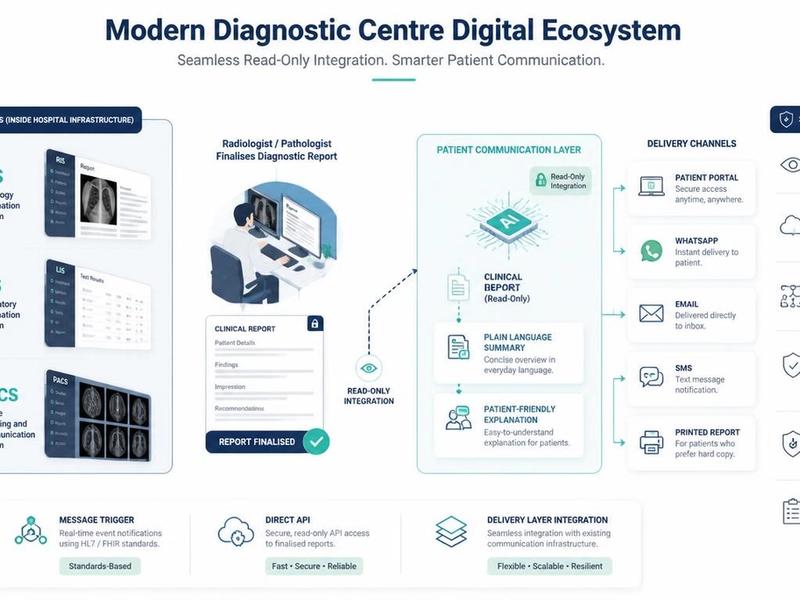
FlexReport is a patient communication layer that sits alongside your existing reporting workflow via API: the finalized report goes out as always, accompanied by a plain-language explanation specific to that report, in the patient's language, with suggested questions for the follow-up visit. It doesn't diagnose, doesn't alter the radiologist's report, and doesn't add a click to the radiologist's day. If the comprehension gap window is showing up in your call logs, we're happy to compare notes on what closing it looks like operationally.
See how it fits your workflow →
FAQ
Does the Cures Act require imaging centers to release reports before the ordering physician reviews them? The information-blocking rules require electronic health information, including finalized imaging reports, to be made available without unreasonable delay. In practice this means reports often reach the patient portal before the ordering physician has read them — the 2024 AJR study found 44% of reports were accessed by patients first.
Can we delay release of sensitive results? Only narrowly. The ONC's Preventing Harm exception permits withholding when release is reasonably likely to cause harm to the patient or another person — it is not a general "let the doctor call first" allowance. Blanket delays risk information-blocking complaints.
Do patients actually want results before their doctor has seen them? Overwhelmingly yes: 95.7% in the JAMA Network Open multi-site survey, including 95.3% of patients receiving abnormal results.
Is a plain-language summary a legal risk? A patient-facing explanation should supplement, never replace or modify, the signed radiology report, and should avoid diagnostic or treatment language. Review any vendor's guardrails with counsel — the Lancet Digital Health review's caveat about oversimplification is the right checklist item.
Does simplifying reports actually improve understanding? The Lancet Digital Health review of 12,922 AI-simplified radiology reports found close to a doubling of patient comprehension, with the caveat that quality controls matter.
What should we measure to size our own comprehension gap? Report-related inbound calls per 100 studies, portal messages per 100 studies, time-to-first-patient-access, and referrer feedback. Baseline for a month before piloting any fix.
References :
1. AJR 2024 multicampus study (www.pubmed.ncbi.nlm.nih.gov/38534191)
2. JAMA Network Open patient-preference survey (via healthit.gov summary)