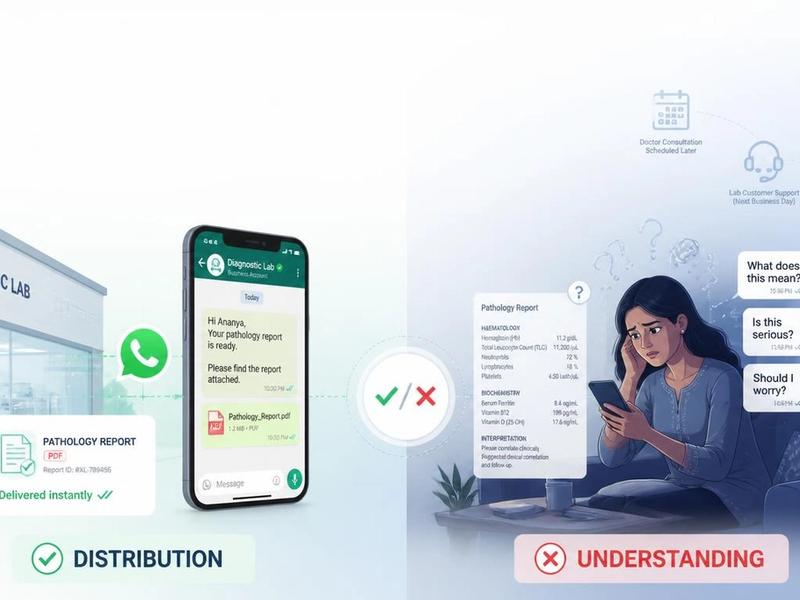
Your phone buzzes and a PDF lands on WhatsApp. It is your scan report from the lab. You open it, scroll past a wall of words you have never seen before, and somewhere in the middle one word jumps out at you: abnormal. Your stomach drops. If that is exactly where you are right now, take a slow breath and read this properly, because the next few minutes matter more than the next few hours.
Here is the short version of what to do after receiving an abnormal medical report. Do not panic, because on a report the word abnormal only means different from the usual, and that covers a huge range. Read the one part the doctor wrote as a summary, usually labelled Impression. Understand the few words that are actually causing the worry. Then take the report to a doctor who can look at you, not just at the page. That is the whole job. Everything below simply walks you through it, calmly.
The hardest part of an abnormal report is usually not the finding. It is the wait between getting the report and getting someone to explain it. In that gap, people Google one frightening word at a time at two in the morning, forward the PDF to the family group, and collect ten opinions from relatives who have never read a scan in their life. FlexReport was built to close that gap. It puts a plain-language second view next to your report, so you can understand what the words mean before you sit in front of your doctor. You can try it with your own report.
You are allowed to feel scared. Just try not to let the fear make your decisions for you. Let us take this one step at a time.
On a report, abnormal simply means different from the usual. It is a description, not a verdict, and it is the start of a conversation, not the end of one.
First, Take a Breath: Why Abnormal Does Not Mean What You Fear
The single most useful thing to understand right now is that abnormal only means different from the typical, expected pattern. It is a description, not a diagnosis. The word covers an enormous range. A small harmless cyst, which is just a fluid-filled sac, is abnormal. A common age-related change in your spine that millions of healthy people walk around with is abnormal. A slightly enlarged organ is abnormal. The word on its own tells you nothing about whether something is serious, harmless, or completely routine. It only tells you the radiologist noticed something worth writing down. Your own doctor will take that finding, add your symptoms, your history and an examination, and only then decide what it actually means for you. So before your mind sprints to the worst possibility, hold on to this: abnormal is the beginning of a question, not the answer to it.
It also helps to know who wrote your report. The doctor who reads your scan is called a radiologist. A radiologist is a fully qualified doctor, an MBBS who then trained for several more years specifically in reading scans like X-ray, ultrasound, CT and MRI. In most labs the radiologist never actually meets you. They study your images, write down everything they see, and pass it on. They are not trying to frighten you. They are trained to note down every little thing so that nothing important is ever missed. That thoroughness keeps you safe. It just happens to read as alarming when you are not used to medical language.
And because this is India, we all know what happens the moment that report arrives. It gets forwarded to the family WhatsApp group within seconds. Two minutes later an uncle has Googled one word, announced the worst, and now your mother is in tears and a cousin is sending links. Hold off on that for just a little while. Read the report properly first. Then, if you want to share it, share it with the calm relative, not the dramatic one.
Read the Impression Section First, It Is the Summary
If you read only one part of your report, read the part labelled Impression. The Impression is the radiologist's summary and conclusion, written in a few short lines, almost always at the very end. Everything above it, usually under a heading called Findings, is the long and detailed description of every single structure they looked at. The Findings section is where most of the scary-sounding words live, and the great majority of those words are just routine notes about normal body parts. The Impression is where the radiologist tells you what, out of all of that detail, actually stood out to them. Reading the Impression first stops you from panicking over one frightening sentence buried in the Findings that the radiologist themselves did not think was important. So scroll to the bottom, find the Impression, and start there. If it is short and uses words like no significant abnormality, that is usually a good sign.
Here is a small but important piece of translation. On a scan report, the word unremarkable does not mean disappointing or careless. It is doctor-speak for normal, nothing of concern. So a line like liver appears unremarkable is exactly the kind of sentence you want to see. Reports are full of these quiet reassurances written in flat, technical language. Once you know that unremarkable is actually a compliment, half the report stops feeling like a threat.
If the Impression still has something in it you do not understand, that is completely normal. You are not supposed to be able to read radiology. That is the whole reason this guide exists, and the whole reason FlexReport puts a plain-language version next to your report. The goal is not to turn you into a doctor. It is to get you to your doctor with a clear head instead of a spinning one.
Understand What You Are Actually Looking At
Most of the panic from an abnormal report comes from a handful of specific words that sound far worse than they are, so let us quietly decode the ones that scare people the most. Take the word lesion. A lesion is simply an area of tissue that looks different from the tissue around it. That is the whole meaning. It is a neutral, catch-all word. A pimple is technically a lesion. A harmless spot is a lesion. The word lesion on its own tells you nothing about whether something is dangerous, so seeing it is not a reason to assume the worst. The same is true for most of the vocabulary in a report. These are precise physical descriptions, not predictions about your future. The table below lists the words that frighten people most, what people assume they mean, and what they usually mean in plain language.
| Word on the report | What people fear it means | What it usually means |
|---|---|---|
| Lesion | Cancer | Any area that looks different from the tissue around it. Often harmless. |
| Mild | A serious problem | A small, minor degree of something. The opposite of severe. |
| Unremarkable | They found nothing useful | Normal. Nothing of concern. A good word to see. |
| Incidental finding | A hidden disease | Something unrelated to why you had the scan that the radiologist noticed in passing. Often harmless. |
| No acute / no significant | Vague bad news | Nothing urgent or important was found. Reassuring. |
| Clinical correlation advised | Something is wrong | A routine request that your own doctor compares this with your symptoms. Not a red flag. |
| Follow-up recommended | It will get worse | A suggestion to repeat the scan later to keep an eye on something stable. Watching is normal. |
If you want to understand the exact words in your own report, we have plain-language explainers for the common ones. You can read what the words on an MRI report usually mean, how to make sense of a CT scan report, or the common terms in an ultrasound or sonography report. Or, fastest of all, upload your report to FlexReport and get a simplified version in minutes, with your terms, from your report, explained without you having to search for each one.
What to Do Before You See the Doctor
Before you see a doctor, your only real job is to arrive prepared and not panicked, and in India that visit can happen far sooner than people elsewhere expect. There is a popular idea online that you must wait five or seven days for an appointment and sit alone with your fear the whole time. That is not our reality. Most of us have a family doctor, a trusted physician, or a clinic within a few minutes of home, and a first conversation can usually happen the same evening or the next morning. So you are not trapped in a week of dread. You can almost always get a real, human explanation within hours. Use that short wait to do three calm things, and they are worth far more than any midnight search on the internet.
- Keep the original report and the scan images safe. The written report is only part of the story. The actual images, whether on a CD, a film, or a link the lab shared, are what a specialist may need to look at later, so do not lose them.
- Write down your symptoms and your questions in your own words. What led to the scan, when it started, whether it has changed, and what you want to ask. Walking in with a written list means you will not freeze and forget everything the moment the doctor starts talking.
- Stop diagnosing yourself online. Reading one frightening forum post is not research, it is self-torture. The internet does not know your history and cannot examine you. Understanding your report is useful. Scaring yourself with it is not.
That instinct to walk into a nearby clinic within a couple of hours is a real strength of how we do things in India, and for a first read and a calm explanation it is perfect. If you simply want to understand the words before that visit, that is exactly what FlexReport is for.
At the Appointment: How to Use Your Report as a Tool
The best way to handle an abnormal scan at the appointment is to treat your report as a tool you are handing the doctor, not a sentence being read out over you. Walk in, give them the Impression to read first, hand over the actual images if you have them, then ask clear, direct questions and write down the answers. Your aim is to leave the room understanding three things: how serious this is, whether you need to do anything now, and what happens next. Doctors are often rushed, especially in busy clinics, so the patient who asks specific questions tends to get specific answers, while the patient who sits quietly and nods gets a quick reassurance and a prescription. You are allowed to slow the conversation down. It is your body and your report. A good doctor will not mind a prepared patient at all.
- What does this finding actually mean for me?
- Is this serious, or is it routine and common?
- Do we need to act on it now, or do we watch it for some time?
- Do I need any other test to be sure?
- What happens if we do nothing?
- Should I see a specialist, and if so, which kind?
After the Appointment: What Happens Next
After the appointment, one of three things usually happens, and all three are normal. Your doctor may tell you the finding is harmless and nothing needs to be done, in which case you can finally breathe out. They may suggest a follow-up scan after a few weeks or months, which simply means the finding is stable enough to keep an eye on rather than treat right away. Or they may send you to a specialist for a closer look or another test. None of these is a disaster, and the watch-and-wait option in particular is not your doctor ignoring you. In medicine, watching something stable over time is often the wisest and safest choice, because many findings never turn into a problem and acting too fast can cause more harm than the finding itself. Whatever the plan is, write it down, and then actually follow it on the date you were given.
One practical habit for the months ahead: keep your scans and reports together, ideally in date order. If you ever need a repeat scan, the most useful thing a doctor can have is your previous scan to compare against. Has this changed since last time is one of the most important questions in all of imaging, and it can only be answered if the old report still exists. So once the scare has passed, do not delete that WhatsApp PDF. Save it in a folder you can find.
And one last gentle piece of advice. Once you have a plan from a doctor you trust, try to stop collecting opinions. We have all seen the relative who visits six doctors, gets six slightly different phrasings, and ends up far more anxious than when they started. A second opinion for a serious finding is sensible and easy to get in India. A sixth opinion is just a way of staying scared. Get informed, pick a doctor you trust, and let yourself move forward.
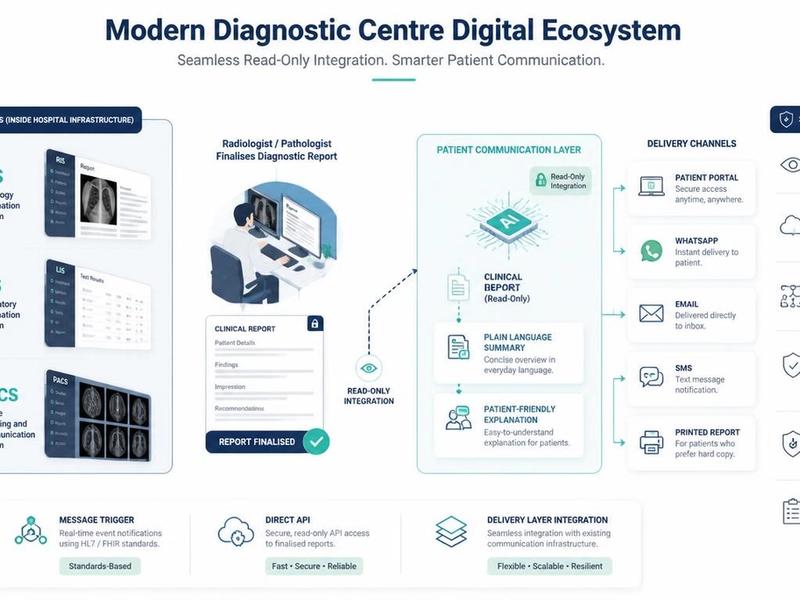
FlexReport is a patient comprehension layer for diagnostic centers, labs, and hospitals. It adds a plain-language second view to medical reports without changing the clinical report itself. It does not replace your doctor or your radiologist. It simply makes the report you already have easier to read, so the wait before your appointment feels a little less frightening.
If you are staring at a word you do not understand right now, you do not have to wait until your appointment to feel calmer. You can upload your report and get a plain-language version in minutes, and share that clearer version with the family group instead of ten different guesses.