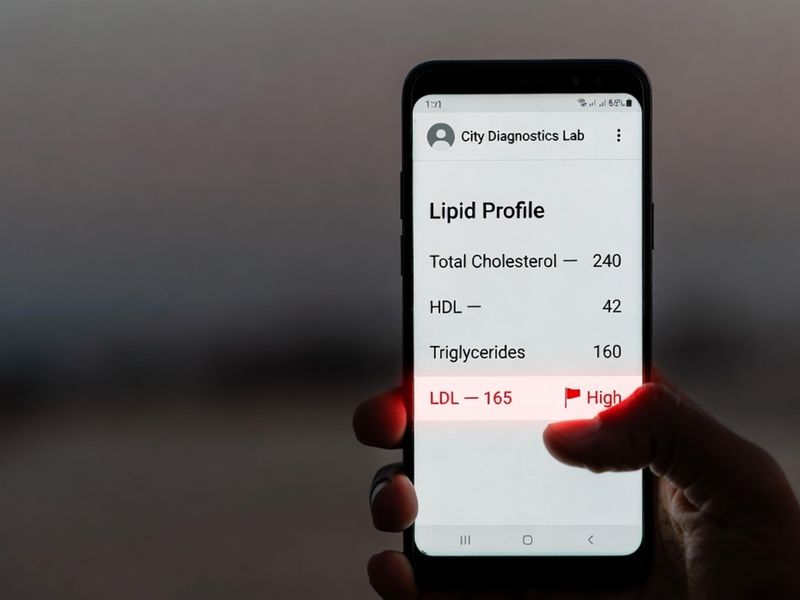
The report came on WhatsApp. Not in a sealed envelope with a doctor sitting across from you. Just a PDF notification from the lab, dropped into your phone at 8 in the evening while you were still at work or sitting at the dinner table.
You opened it. You read the first line. You didn't understand it.
So you did what most people do. You forwarded it to the family group. Your father called within two minutes. Your bua suggested a different hospital. Someone sent a screenshot to a cousin who "knows something about medical stuff." The chemist downstairs looked at it and said "haan, thoda serious lagta hai." By 10pm, four people had opinions and none of them actually knew what the report was saying.
You'll probably see a doctor tomorrow. Maybe even tonight if the anxiety gets bad enough. India isn't short on doctors and you won't wait five days for a consultation the way people do elsewhere. But seeing a doctor quickly doesn't automatically mean you'll understand what's happening. Not if you walk in overwhelmed, the appointment is rushed, and your doctor is speaking in medical language while you're still trying to calm down.
This guide is for the hours between receiving the report and sitting in front of a doctor. It won't replace that conversation. But it'll make sure you actually get something useful out of it.
Why your scan report feels impossible to read
When you pay Rs. 3,000 or Rs. 6,000 for a CT scan or an MRI, you expect to understand what you're getting back. That's a fair expectation. You paid for it. You sat in the machine. You waited for the report. You deserve to know what it says.
But radiology reports are written by radiologists for the doctors who referred you. The language is clinical, compressed, and full of terms that only make sense if you've spent years reading them. Words like "hypodense lesion," "foraminal narrowing," or "ill-defined opacity" are normal parts of a radiologist's daily vocabulary. For everyone else, they sound alarming even when they aren't.
Here's the part nobody tells you. A lot of what sounds frightening in a radiology report is either routine, very common at your age, or only meaningful alongside other findings. The report isn't designed to communicate urgency or reassurance. It's designed to pass information between two clinicians. The emotional interpretation is something you're doing yourself, without the training to do it accurately.
That's why the family group chat always spirals. Everyone is reading real words and filling in the meaning with fear.
Step 1: Read the Impression section first, nothing else
Every radiology report has a structure. There's a Clinical History at the top, a long Findings section in the middle, and an Impression or Conclusion section at the end.
Start with the Impression. Only the Impression.
This is where the radiologist summarises what actually matters. It's short, direct, and written to communicate the key findings to the referring doctor. If something significant was found, it will be here. If the scan was mostly normal with minor observations, the Impression will reflect that.
The Findings section is where most of the midnight panic comes from. It documents everything the radiologist observed while going through the scan, including normal anatomy, minor age-related changes, and things that appear in perfectly healthy people. If you read that section without any context, you'll hit a phrase like "small hypodense focus in the right hepatic lobe," Google it, and land on something completely unrelated to your situation.
Read the Impression first. Let it tell you what actually matters. Then go back to the Findings only if you need more detail on something mentioned there.
Step 2: Look up unfamiliar terms the right way
Once you know which findings to focus on, you'll probably have terms you don't recognise. Looking them up is fine, but how you look them up matters a lot.
The wrong way is typing a raw medical term straight into Google. The results will give you clinical papers, condition-specific forums, and pages that have no way of knowing your age, your health history, or the full context of your report. A term that's completely unremarkable in a 45-year-old's routine scan can appear on the same search page as something serious. Your brain will pick the scarier interpretation every time. That's just how anxiety works.
The better way is to look for patient-focused explanations of what that term typically means in a scan report. What does it usually indicate? How common is it? Is it something doctors see regularly without concern?
A dedicated radiology glossary written for patients is a much better starting point than a general search. [Link to FlexReport radiology terms glossary]
Write down what you find. You'll need it in the next step.
Step 3: Write one question per finding you don't understand
This is the step that will actually change your appointment. And almost nobody does it.
After reading the Impression and looking up the terms that confused you, take each finding you're still unsure about and write one honest question. Not a medical question. Just the real one you're sitting with.
"The report says there's a disc bulge at L4-L5. Is this something I should be worried about at my age, or is it common?"
"There's a mention of a small cyst on the kidney. Does this need treatment or is it something you see often?"
"The Impression says mild fatty infiltration of the liver. Does this mean something serious or is it related to my diet?"
You don't need to know the answer before you go in. The point is to arrive with specific questions rather than a general sense of anxiety. A doctor in an eight-minute consultation can answer three clear questions well. They cannot, in that same time, undo an entire evening of family WhatsApp panic and unstructured Googling.
Write the questions down. On paper or on your phone. Whatever you'll actually have with you.
Step 4: Note your symptoms before you go
Doctors connect what the scan shows to what you've been experiencing. The scan is one part of the picture. Your symptoms are the other.
Before you go, write down when the symptoms started. Not just "a while back" but as close to an actual timeframe as you can remember. How they've changed over time, whether they've gotten worse, come and gone, or stayed the same. What makes them better or worse, whether that's movement, rest, eating, or a specific time of day. And what you were most worried about when you first decided to get the scan done.
Most people plan to mention all of this at the appointment and forget half of it once they're in the room. A doctor asking questions, a fast-moving conversation, and a bit of anxiety is a reliable way to forget the thing you most wanted to say.
Five minutes before you leave. Write it down
Step 5: Get a plain-language breakdown before your appointment
If your report has more than two or three findings, or the language is still confusing after the steps above, this one is worth doing.
FlexReport's Engine takes your scan report and works through it finding by finding, converting the clinical language into plain explanations you can actually read. Not a general description of what terms mean medically, but a specific breakdown of what your report is saying, in language that makes sense.
It also puts together a short list of questions based on your specific findings, so you're not starting from scratch when you think about what to ask.
A lot of patients in India get their reports on WhatsApp and see a doctor the same day or the next morning. The window is short. But even an hour of actually understanding your report before you walk in changes the quality of that conversation. You stop listening in fear and start listening with some context behind you.
What to actually bring to your appointment
Bring the report itself, either printed or on your phone and ready to show.
Bring your written questions from Step 3 and your symptom notes from Step 4.
If you've had a scan of the same body part before, bring that report too. Comparison over time is often the most useful thing a doctor has, and having the old report saves everyone time.
If you have a family member who can stay calm and actually listen, bring them. Not the one who panicked in the family group last night. The one who will pay attention and remember what was said after you leave the room.
How to make the most of a consultation that might last 8 minutes
Indian doctors, especially good specialists, are busy. Your appointment might be shorter than you expect. That's not a reflection of how much they care. It's just the reality of how things work.
Lead with your questions. "I have three things I want to understand from this report" is a more useful opener than arriving looking worried and waiting for the doctor to explain everything from scratch.
Ask specifically about urgency for each significant finding. Does this need follow-up, and if so, how soon? You want to leave knowing whether something needs attention in the next week or can wait for your next check-up.
Ask what normal looks like for your specific situation. Many findings that sound alarming in a report are very common at your age, with your history. "Is this something you'd typically watch or treat?" is a useful question for almost anything.
If the doctor uses a term you don't understand, ask them to explain it differently. You're not wasting their time. A patient who understands their own situation is easier to treat.
And if you leave with more questions than you came in with, you can always go back. Or see another doctor. You paid for this scan. You're entitled to actually understand what it found.
FAQs
I can see a doctor quickly in India. Do I still need to read the report myself? Yes. Seeing a doctor fast and actually understanding what they're telling you are two different things. Walking in with context means you ask better questions and leave with real answers, not just a prescription you don't fully understand.
My family is already sending the report to everyone. Is that helping? Probably not. The chemist, the relative who studied medicine for a year, the neighbour who "knows a doctor" — they all mean well, but none of them have your full medical history. More opinions without context usually means more panic.
What is the Impression section and why should I read it first? It's the summary at the end of the report where the radiologist tells the referring doctor what actually matters. It's shorter, clearer, and far less alarming than the full Findings section. Start there every time.
Why does my report sound so scary even if my doctor seems calm? Because reports are written in clinical language, not reassurance language. A radiologist's job is to document what they observed, not to tell you how worried to be. Something that reads as alarming in a report is often completely routine to the doctor reading it.
Is it okay to Google the terms in my report? You can, but be careful. General search results have no idea how old you are, what your symptoms are, or what the rest of your report says. A term that's unremarkable in your context can sit on the same results page as something serious. Use a patient-focused radiology glossary instead.
I paid Rs. 5,000 for this scan. Why can't the lab just explain it to me? Labs generate the report. Interpreting it for your specific clinical situation is the doctor's job, not the lab's. It's a gap in the system and it's genuinely frustrating. That gap is exactly what FlexReport is built for.
Can I show a FlexReport breakdown to my doctor? Yes, and most doctors appreciate it. A patient who arrives with a clear summary and specific questions makes for a more productive consultation. It saves time and means the appointment is spent on what matters.
What if there's a finding I still don't understand after reading the breakdown? Bring it as a direct question to your doctor. Write it down exactly as you don't understand it. "The report says X. FlexReport explained it as Y. I still don't understand what that means for me." That's a clear, answerable question for any doctor.
Should I get a second opinion if I'm not satisfied? If something significant was found and you're not comfortable with the explanation you received, yes. India has no shortage of specialists. A second opinion is not an insult to your doctor. It's your right as a patient.
My parents got the scan done. How do I explain it to them? Use the Impression section as your starting point. Read it to them in simple terms and avoid the Findings section unless you've already looked up what the terms mean. FlexReport's Engine can give you a plain-language breakdown you can share with them directly, which takes you out of the position of having to translate something you're also trying to understand yourself.
You got the report on WhatsApp. Your family is worried. You're trying to figure out if this is serious before you see the doctor tomorrow.
FlexReport's Engine breaks your report down into plain language, finding by finding, and gives you a short list of questions to bring to your appointment. It works on any radiology report, takes a few minutes, and exists specifically for this moment. The one where you have the report in your hand and no one to explain it.