You're not overreacting.
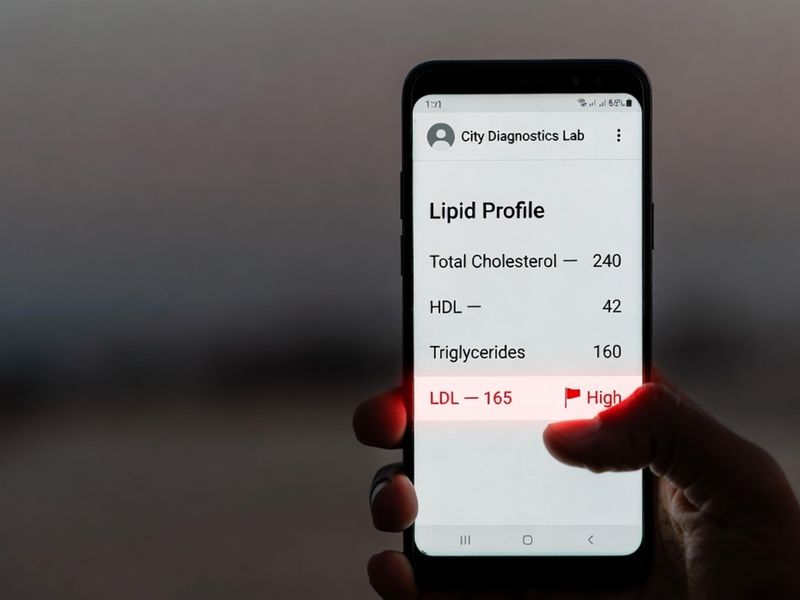
You went in for a scan, maybe at a neighborhood diagnostic center or an Apollo or a Fortis. They handed you the report in a sealed envelope, or sent a PDF directly to your phone. You told yourself you'd wait for the doctor to explain it. You lasted about four minutes before you opened it.
Now you're staring at words like "heterogeneous echotexture" and "mild hepatomegaly" and your stomach has dropped.
If you're feeling anxious after receiving a medical scan report right now, this page is for you. And before anything else: this is one of the most normal things a person can feel. It has a name, it's well-studied, and it makes complete sense given the situation you've just been put in.
You are not a radiologist. You were never meant to read this document alone. The anxiety you're feeling is your brain responding to an incomplete picture, not to a diagnosis. This post explains exactly why it happens, why the well-meaning chaos that follows in most Indian households makes it worse, and what actually helps.
1. What Is Scanxiety and Why Does It Happen?
Scanxiety is the word researchers use to describe the anxiety that surrounds medical imaging, before the scan, during it, and especially after you receive a medical scan report. It's not a clinical diagnosis, but it's a well-documented experience studied across oncology and cardiology settings by institutions like Memorial Sloan Kettering and University of Michigan Health.
And it doesn't only affect people who already have a serious condition. It hits people who came in for a routine check-up. It hits people who feel completely fine physically. Being anxious after receiving a medical scan report has nothing to do with how sick you are or aren't. It has everything to do with being handed a document you weren't trained to read, by yourself, with no explanation attached.
Your medical scan report was written by a radiologist for another doctor. The language is clinical shorthand between two trained professionals. When it lands in your hands without that translation layer, you're reading something in a language you were never taught, and being left alone with it. That's not a personal failure. That's just how the system currently works.
2. Why Uncertainty Is Psychologically Harder Than Bad News
Not knowing is genuinely harder on your nervous system than bad news. Most people find this surprising, but the research is consistent.
A 2016 study published in Nature Communications found that people experienced more stress when there was a 50% chance of a negative outcome than when they knew for certain the negative outcome was coming. Certainty, even bad certainty, allows your brain to stop scanning for threats and start processing. Uncertainty keeps the alarm running.
This is why being anxious after receiving a medical scan report can feel so draining, even when nothing serious has been found. Your brain is running a threat-detection loop it cannot switch off because it doesn't have enough information to resolve the question. It's not weakness. It's your nervous system doing exactly what it was designed to do, just in a situation it was never designed for.
3. Why Googling Your Medical Scan Report Makes It Worse
You already know you shouldn't Google it. You did it anyway. So did most people reading this.
The problem isn't just that Google gives you scary results. It gives you scary results that feel authoritative. You search "hypoechoic nodule thyroid" and the top results are about thyroid cancer. What you don't see is that the vast majority of hypoechoic thyroid nodules are completely benign and require no treatment at all. Search engines optimize for engagement, and medical anxiety drives clicks, so results are skewed toward alarming interpretations regardless of how common or uncommon those interpretations actually are in clinical practice.
There's also a context problem no search engine can solve. The same finding in a medical scan report means entirely different things in a 25-year-old versus a 60-year-old. It means something different depending on your symptoms, your history, and your other investigations. Google doesn't know any of that. Your doctor does.
And then there's the rabbit hole specific to the Indian internet experience: you end up in a Facebook health group or a Quora thread where someone describes findings that sound exactly like yours, and they were diagnosed with something serious. That thread now lives in your head. Close it. That person is not you, and their clinical context is not yours.
4. The Indian Reality: You Have the Report, But Not the Context
In most countries, patients receive their medical scan report after speaking with their doctor. In India, it usually works the other way around.
You get your printed report within a few hours, sometimes within 30 minutes at a walk-in diagnostic center. It's handed to you at the reception desk, or the PDF arrives on WhatsApp from the lab before you've even reached the parking lot. No one sits you down. No one explains anything. You just have it.
What happens next is something almost every Indian family will recognise.
You photograph it and forward it to the family WhatsApp group. Within minutes, someone has a view. Chacha ji who studied MBBS 30 years ago says "yaar yeh dekh ke lagta hai serious ho sakta hai." Your mother's friend's son who is a doctor in the US sends a voice note at 2am saying "don't worry, it's nothing." Your neighbour says her sister had something similar on her report and it turned out to be nothing. Another relative says her husband had the same words and needed surgery.
Now you have five different interpretations from five people who have not examined you, don't have your full medical history, and are each responding to one isolated line of a technical document.
Each piece feels like it might be the one that finally resolves the uncertainty. None of them do. Every new input adds a new variable to the loop your brain is already running. This is the real reason people feel more anxious after receiving a medical scan report in India than in most other healthcare settings. It's not lack of access to doctors. It's an overload of unstructured information from people who genuinely love you and are genuinely trying to help.
The appointment situation compounds it further. Your regular doctor is packed for four days. Someone at home says "itna time mat lagao, seedha specialist ke paas jao." You go to a specialist cold, without your full history, and get five minutes in the consultation room before the next patient is called in. You come out with more questions than you went in with.
None of this is anyone's fault. The gap isn't access. It's structure.
5. What Actually Helps Right Now
Before you send that medical scan report to anyone, read it once yourself first. Write down every word or phrase you don't understand. Don't Google them yet. Just list them. This gives your anxiety something concrete to do instead of running in circles.
Decide who you actually want to share the report with. In Indian families this is genuinely hard because there's a cultural expectation that health information is family information. But every informal opinion adds another interpretation layer to an already confusing document. It's okay to say "I'll share properly once I've spoken to my doctor." That's not secrecy. That's just sense.
When you do see a doctor, go in with specific questions written down. Indian consultations, especially in private hospitals, are often short. Doctors are managing enormous patient loads. If you go in anxious and unprepared, you'll spend the time explaining your feelings rather than getting clinical answers. Written questions change that dynamic entirely.
Let someone sit with you in the uncertainty, not to give opinions, just to be there. There's a real difference between calling someone who will immediately catastrophise and calling someone who will just keep you company while you wait. You're allowed to need the second kind of support.
And stop re-reading the report. You've read it. Reading it again doesn't give you new information. It just gives your anxiety more material to work with.
6. How FlexReport Gives You a Structured Alternative to the Spiral
FlexReport takes your medical scan report and translates it into plain language, then generates a specific set of medically-grounded questions you can bring into your consultation.
It doesn't diagnose. It doesn't tell you what your results mean clinically. What it does is convert an intimidating technical document into something structured and usable, before the family WhatsApp group gets involved, before the informal opinions start stacking up, before your five-minute consultation slips away in confusion.
If you're anxious after receiving a medical scan report and have an appointment coming up, this is the most useful thing you can do between now and then.
FAQs
What is scanxiety and why is it so common in India?
Scanxiety is the anxiety that follows receiving a medical scan report before any doctor has explained it. In India it hits harder because you get the report within hours, and the family opinion pile-on starts almost immediately after.
Why am I so scared of my MRI or CT results even though I feel physically fine?
Because the anxiety isn't about your symptoms, it's about uncertainty. Your brain can't stop running a threat-detection loop until the question is resolved with actual clinical information.
How do I stop worrying about scan results?
Write down every term you don't understand and turn it into a question for your doctor. It gives your anxiety a job to do instead of a spiral to run.
What is the number one worst habit for anxiety after receiving a medical scan report?
Googling terms from the report. Results are skewed toward worst-case scenarios because alarming content gets more clicks, not because it's more likely to apply to you.
Everyone in my family has a different opinion about my report. What should I do?
Don't try to resolve a medical scan report through family consensus. Write your questions down and bring them to your doctor. That's the only opinion that has your full clinical context.
You Don't Have to Figure This Out Alone
The moment after you receive a medical scan report, before anyone has explained it, before the appointment, before the noise starts, that's the moment FlexReport is built for.
Upload your report and get a plain-language translation with a clear set of questions to bring to your doctor. Not a diagnosis. Not another opinion. Just structure, in a situation that needs it.